

BTW 2025 Data Science Challenge
The accepted submissions can be found here.
UPDATE From January 27, 2025: Clarification & Updated Template
- We updated the submission template (Jupiter notebook file) with additional functions to you prepare your submission and make sure you have the right form it for the predictions (PDF / Archive)!
- We updated the info on submission artifacts as well to avoid confusion: Submissions must include (1) a single PDF file (report), (2) a CSV file (predictions) and (3) a ZIP archive (Jupyter notebook file + optional artifacts)
If you have any any questions regarding the upcoming deadline or submission, please reach out!
New Approach: Challenge Comes With Integrated University Course!
We invite you to participate in the Data Science Challenge at the upcoming BTW 2025, focusing on the task of forecasting hourly energy prices.
This year, we are taking a fresh approach to the Data Science Challenge by integrating it into a course that can be easily conducted by other instructors. Professors, research associates, and other teaching staff are encouraged to conduct a seminar on the challenge topic, allowing students to develop their submissions during the semester.
Our goal is to enhance visibility within the community and increase the number of submissions by making participation more attractive for students. Participants will predict electricity prices for a specified day, using the skills and tools learned throughout the course.
Open for All: Students, PhD Candidates, Independent Researchers
Submission is open to everybody. While we particularly encourage students enrolled in the integrated seminar to take part, the challenge is also open to other students who wish to independently tackle the problem. Additionally, non-university researchers and research groups are welcome to participate.
Challenge Goal: Electricity Price Forecasting
Day-ahead prices are the prices set for electricity delivery on the next day, determined through a daily auction process based on anticipated demand and supply. These prices provide a forecast that helps producers and consumers plan their generation and consumption, reflecting expected market conditions. Predicting these prices is crucial for energy companies and traders to optimize their operations, manage risks, and improve market efficiency.
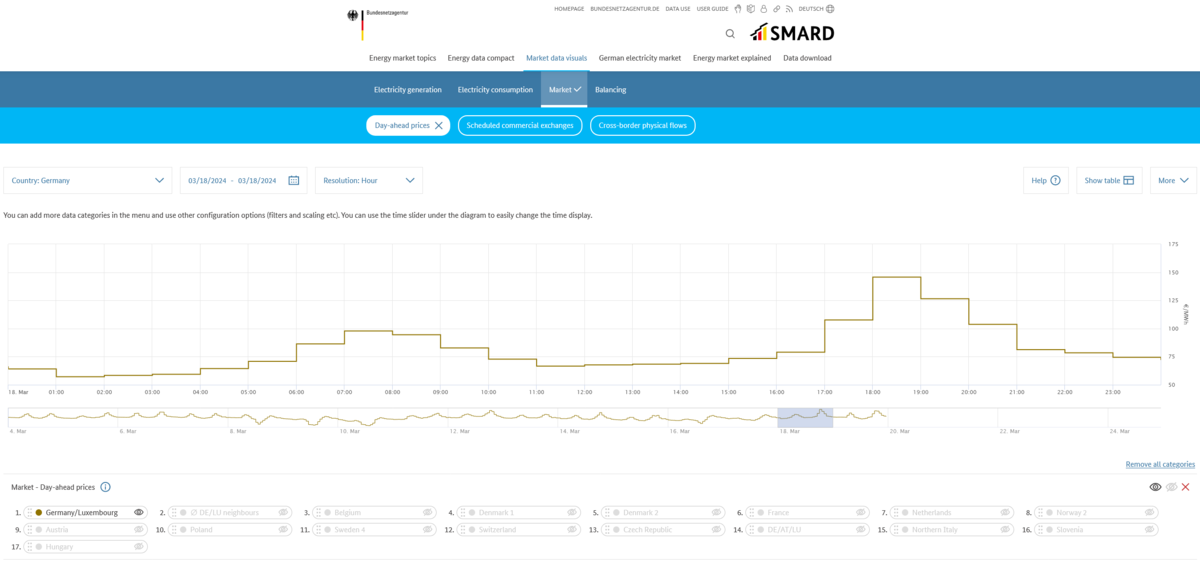
As the goal of the upcoming BTW 2025 Data Science Challenge, you will build a model to predict hourly day-ahead energy prices for Germany on February 18, 2025 as reported by the SMARD.de information platform (see Figure 1 below for an example showing data for a different date in the past).
Phases of the Project
The work on the data science challenge can be roughly partitioned into the following 4 phases:
- Gathering Domain Knowledge & Data Sources: Collect and analyze relevant data sources, build an understanding of the domain.
- Data Cleaning & Exploratory Data Analysis (EDA): Prepare your data for a downstream analysis, for example by removing anomalies, investigating variable relationships, and creating statistical summaries.
- Visualization & Storytelling: Plot trends and forecasts, evaluate model performance visually, and explain your findings in a compelling narrative.
- Predictive Modelling: Develop a forecasting model, compare it against a reasonable baseline, and iterate on it.
We recommend following the same structure in the submitted reports.
Please Help Us Plan Ahead and Register Now!
If you intend to work on the challenge, please
- register
- and create your submission in ConfTool for the data challenge track now already.
Having a rough overview over the number of potential submissions will help us in planning and notifying all participants in case of updates. Thanks!
Challenge and Submission Parameters
Participants will predict hourly energy prices for a specific day, utilizing a variety of data sources and analytic techniques. The challenge is to create a comprehensive report in the form of a Jupyter Notebook, covering four thematic areas:
- Objective: Predict hourly electricity prices for the designated target date immediately after the project report deadline, i.e. predictions should contain 24 values with 1 value per hour of the target date.
- Submission Details: Participants will submit a report divided into four key phases (see below), detailing their prediction and how it was created. In more detail:
- What?
- 1 single PDF file with your report,
- 1 CSV file with your predictions,
- 1 single Jupyter notebook file (Python 3.X) with optional artifacts (e.g. crawled data)
- Note: due to ConfTool restrictions, this must be send together inside an archive.
- Where? Submission via ConfTool
- Why? You will gather experience and get to know new people! (... and you have a chance to win a price!)
- What?
- Team Composition: Participants will work in small groups, e.g. groups of three.
- Note on Group Size: Please note that the challenge is open for all, meaning you can also submit as a professional or create one submission with an entire course of students.
- Course Timeline:
- Start: October 2024
- Project Report Deadline: End of January or early February 2025 (Remark: This is only for your internal planning and allows instructor feedback. The deadline for the challenge can be found below.)
- Challenge Deadline: February 17, 2025, 12:00 GMT+1
- Notification of Acceptance: February 25, 2025, 12:00 GMT+1
Suggested Semester Structure
The challenge will be structured around a seminar phase, where participants will attend presentations and engage in discussions to deepen their understanding. This phase is crucial for developing a well-rounded submission. Each team will document their progress and insights in a Jupyter Notebook, divided into the thematic areas specified above.
The suggested semester structure is outline below:
- Kick-Off (Week 1): Presentation by course instructors (see slide template below), group assignment, choosing seminar topics.
- Seminar Phase (Weeks 4-6): Student presentations on topics relevant for working on the challenge such as:
- Electricity market pricing mechanisms (Merit-Order, etc.)
- Power market structures and operators
- Introduction to Python and Jupyter Notebooks
- Data Cleaning, Bias, and Correlation
- Best Practices in Visualization and Data Storytelling
- Interactive Visualization Techniques
- Predictive Modelling Approaches
- Practical Phase (Weeks 7-13): Bi-weekly meetings to present progress and discuss issues.
- Submission (Week 14): The groups present their results and hand in project reports.
Submission for Data Science Challenge: Analysis as Jupyter Notebook
Following the course, participants can use instructor feedback to make minor adjustments to their project reports and submit them for the Data Science Challenge.
Submissions must include a single PDF file (report), a CSV file (predictions) and a ZIP archive (Jupyter notebook file + optional artifacts). Remark: The submission must be done inside a single archive file.
All submissions will be reviewed a jury. Selected contributions will be given the opportunity to present their results as a poster/demo at the BTW conference (in the poster and demo reception) and winners will be honored at the conference dinner. Please refer it to the conference program plan for more info as it becomes available.
Resources
- Challenge Task: PDF / Archive with Jupyter Notebook File and Sources that you can use as a template for your report
- Instructor Slides: PowerPoint / PDF template for course kick-off meeting
We look forward to seeing innovative approaches and thorough analyses from all participants. Good luck!
Jury
Michael Behringer, Universität Stuttgart
Michael Brand, OFFIS
Stefan Deßloch, Universität Kaiserslautern
Maria Fernanda Davila Restrepo, Universität Oldenburg
Tobias Grimm, Enercon
Florian Heinz, Hochschule Regensburg
Wolfgang Lehner, TU Dresden
Felix Naumann, HPI
Martin Poppinga, Universität Hamburg
Tilmann Rabl, HPI
Mareike Schmidt, Universität Hamburg
Andreas Thor, HTWK Leipzig
Benjamin Wollmer, Baqend
Chairs
Wolfram Wingerath (University of Oldenburg)
Marco Grawunder (University of Oldenburg)
Contact: data-science@uni-oldenburg.de
Sponsoring
The Data Science Challenge is supported by the BTC AG with prize money totaling 1000 euros.